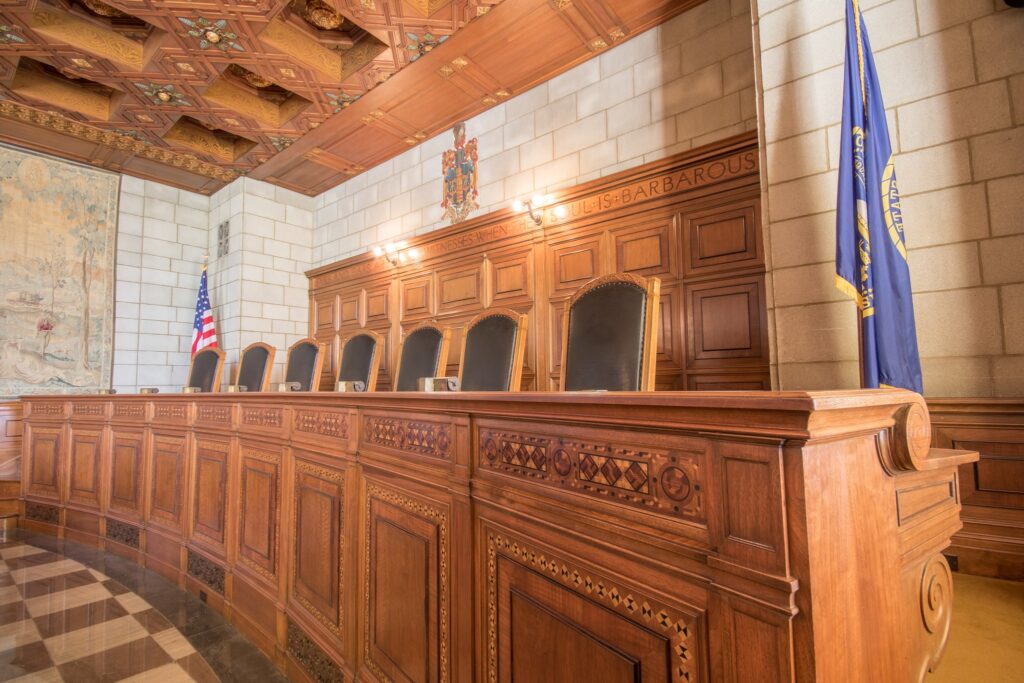
On December 2, the Nebraska Supreme Court heard oral arguments in one of the most important public sector collective bargaining cases in nearly two decades. Our union filed suit in 2023 after the Governor refused to negotiate with our union over the terms and conditions of remote work assignments.
It is our belief that the Nebraska State Employees Collective Bargaining Act requires the Governor to negotiate. While the facts of this particular case are about remote work, when the Supreme Court issues a decision in 2026, the rights of all public employees to negotiate the terms and conditions of their employment will be clarified for the future.
NAPE/AFSCME attorneys Dick Griffin, Kara Naseef, and Abby Osborn argued that both the law and case law is clear that the governor must negotiate. During arguments Justice Jonathan Papik questioned Mr. Griffin on whether there was actually bargaining over remote work. “Bargaining involves give and take,” said Griffin. “Bargaining involves counter proposals. Even hard bargaining involves some response, and then the parties look to other provisions of the contract where they can reach compromise. This was not bargained over.”
Arguing on behalf of the State of Nebraska, deputy solicitor general Zachary Viglianco argued that the governor was well within his right to unilaterally control remote work assignments, and that was the state’s strategy during negotiations.
Additionally, our union argued that the unprecedented order from the Commission of Industrial Relations requiring NAPE/AFSCME to pay the State of Nebraska over $40,000 in legal fees was contrary to the law. Our union has a duty to represent our members, and awarding legal fees would chill public employees from filing complaints at the Commission of Industrial Relations in the future.
If you were unable to attend, a recording of the hearing is available here. We expect the Supreme Court to make a final decision in the first half of 2026. Regardless of the outcome, the court will provide needed clarity on our rights under the law, and union members will have stood united fighting for our rights to our state’s highest court. If you are not a union member, join your colleagues and stand with us today.